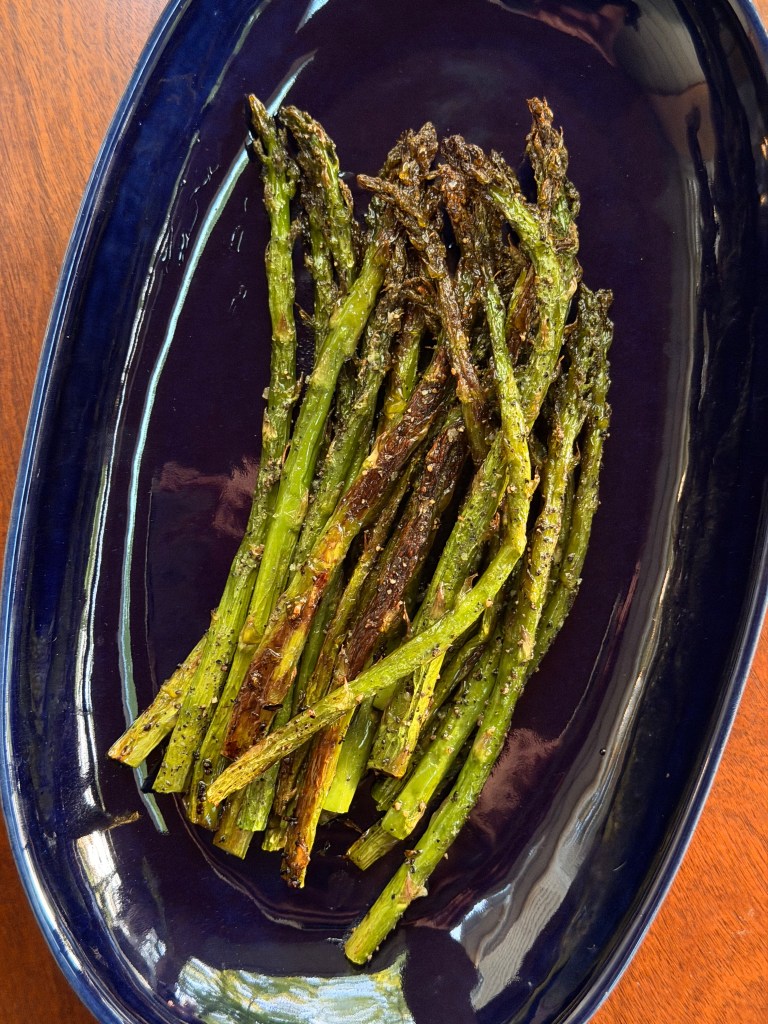
This recipe was born from a small kitchen fire I made by accident as a teenager and never told my parents about. My friend and I wanted to do a simple asparagus roast with olive oil, but we added way too much olive oil, and it started splattering in the oven and lit up from contact with the heating elements. We noticed it within moments and turned the oven off, and the fire died away naturally before anything bad happened.
The flamed asparagus were unlike anything I’d ever tried. Instead of charring, they had fried. The tips were crispy beyond belief, and the stems were melted and soft. For years I labored and ate abnormal volumes of asparagus in my efforts to recreate the results *without* starting a fire.
The technique I developed focuses on saturating the petaled tips of the asparagus with olive oil, and then using the oil that drains off to coat the stems. Getting oil behind, around, and between the petals is what enables them to fry to a crisp in a hot oven instead of steaming and turning soft. Using the runoff for the rest of the asparagus body keeps the puddling and splattering low.
But the real key to that sublime crispy texture is letting the asparagus cook for *long enough.* Often they need to be taken beyond the point at which they begin to smell burnt. They only start to really taste good once they begin to smell like something you’ve forgotten about.
Ingredients
- 1 bundle asparagus
- Olive oil (I use Flamingo Estate)
- Salt (I use sel gris)
- Black peppercorns in a grinder
- (Optional) Dry mustard powder
Preparing the asparagus
Preheat the oven to 425˚F / 220˚C if your asparagus are chonky, or 450˚F / 230˚C if your asparagus are pencil thin.
Rinse the asparagus and pat them dry *well* with an absorbent towel. You don’t want moisture remaining!
Snap all the asparagus stems at their natural breaking point. I find myself snapping off the bottom 1/3 most of the time. Don’t worry if some of the stems end up surprisingly short, trust that it’s not a loss. You wouldn’t prefer to gnaw on fibrous stems.
Line up the asparagus snugly on a baking sheet, with the tips all aligned in a neat row. Leave some room between the edge of the pan and the asparagus tips.
Drizzle the olive oil over the tips of the asparagus *very* slowly, moving down the line as each of the tips seems to become “full.” You will end up with a puddle of olive oil on the tips side of the pan.
Part the layer of asparagus like the Red Sea into two aligned little bundles. One at a time, rotate a bundle 90 degrees and roll the asparagus stems around in the linear puddle of oil on what used to be the tips side, until all the asparagus seems evenly coated. It’s okay if the coating is very light.
Rotate the asparagus bundles again so they’re facing the same way as before, and now line them up on the pan in a single flat layer. You don’t have to align the tips this time. Just make sure the stems aren’t overlapping.
Seasoning the asparagus
Sprinkle a thin layer of salt evenly across all the asparagus.
Grind black pepper over the asparagus. I love to use *copious* amounts of black pepper because I feel like the robust flavor of asparagus can rise to meet it.
If you wish, sprinkle a dusting of dry mustard over the asparagus.
I don’t stir everything around to coat both sides – I just let the seasoning be on the upper surface. The browning will end up on the bottom surface, so both parts of the asparagus get to shine.
Roasting the asparagus *enough*
Make sure the oven is nice and hot – don’t start too early. Some ovens need 20-30 minutes to get properly up to temperature, even if they read as preheated.
Roast the asparagus for 25 minutes (if chonky) or 18 minutes (if pencil thin). Don’t take them out of the oven while they’re still green – let the bottoms and the tips get nice and deeply browned, beyond the point of golden. Wait for the structural integrity of the stems to collapse so the asparagus seems deflated.
Serving
During asparagus season I’m known to roast up a bundle of asparagus and just eat the whole thing neat, by myself, for a casual lunch, five times a week, like a *creature.* But this dish dresses up nicely.
To serve as a side dish, you could top the roasted asparagus with grated parmigiano and pine nuts, or a lemon based dressing (Hollandaise is a classic, aïoli a close second).
For an Italian style breakfast, you could top the asparagus with a fried egg or two and thick shavings of pecorino. Sop up the saucy bits with a side of evoo brushed toast.
You could chop the asparagus into bite sized pieces and mix them into a lemon and ricotta dressed pasta dish.
 Malefic Manach Test
Leave a comment